The Beast of Bray Road: What the Elkhorn Witnesses Actually Reported
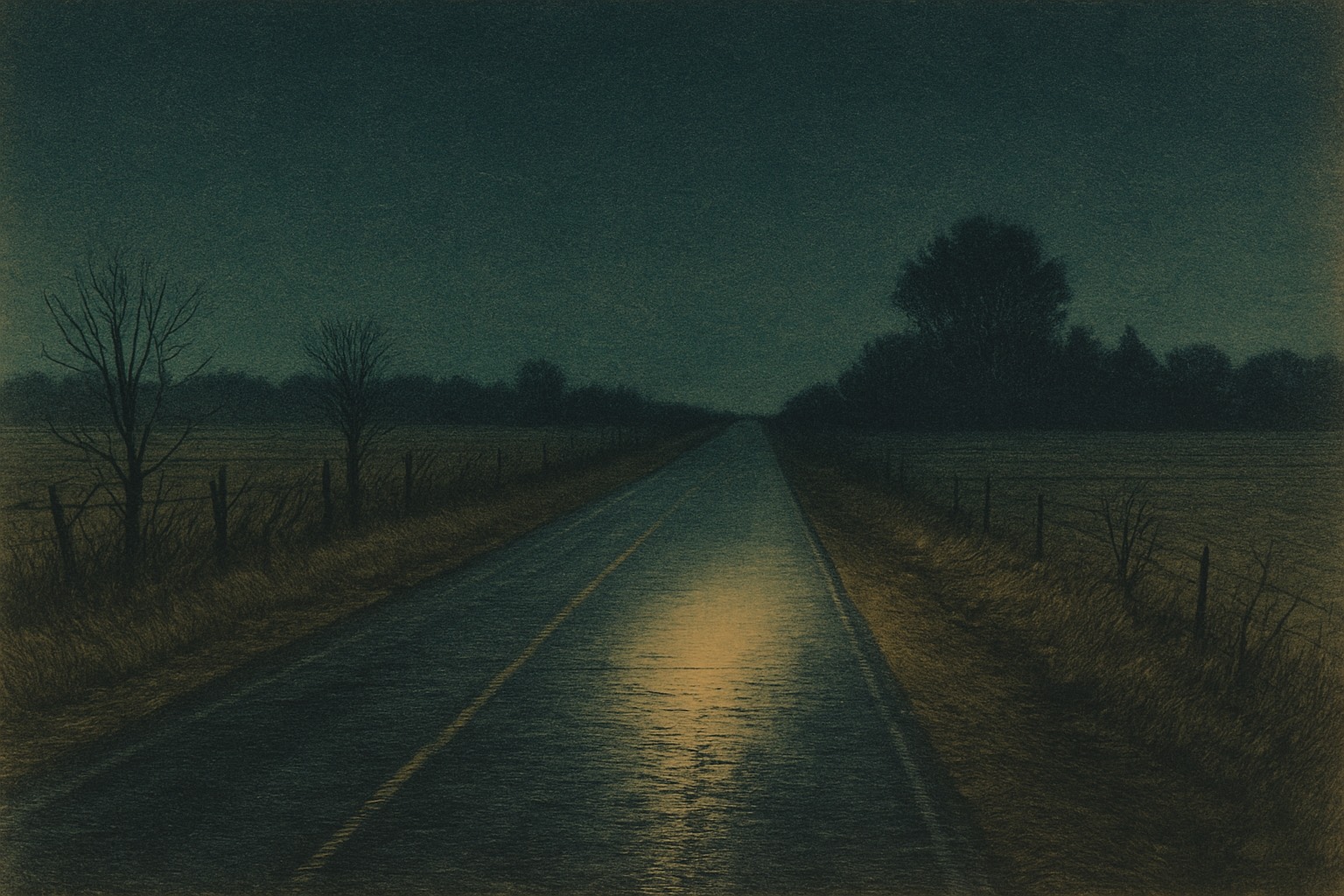
Halloween Night, 1991
On the night of October 31, 1991, a young woman named Doristine Gipson was driving on Bray Road, a quiet stretch of farm road outside Elkhorn, Wisconsin, when she felt her front tire jump — as if she'd hit something. She stopped, got out, and looked back down the dark road. What she reported next became the anchor of one of the strangest sighting clusters in the Midwest: a large, dark, hairy form rising and rushing toward her. She got back in the car and pulled away; she reported that the animal lunged onto her trunk before sliding off the wet pavement.
Two details make her account worth more than a campfire story. First, she went back. Later that same night, driving a young neighbor to a Halloween event, Gipson returned to the spot — and reported seeing the large form again at the roadside, at which point she left for good and started telling people. Second, when she did start telling people, she found out she wasn't first. When her story circulated, it turned out that people in Walworth County had been quietly reporting the same kind of animal on and around Bray Road for at least two years — and mostly keeping it to themselves, for exactly the reason you'd expect. Nobody wants to be the person who saw a werewolf.
The Location
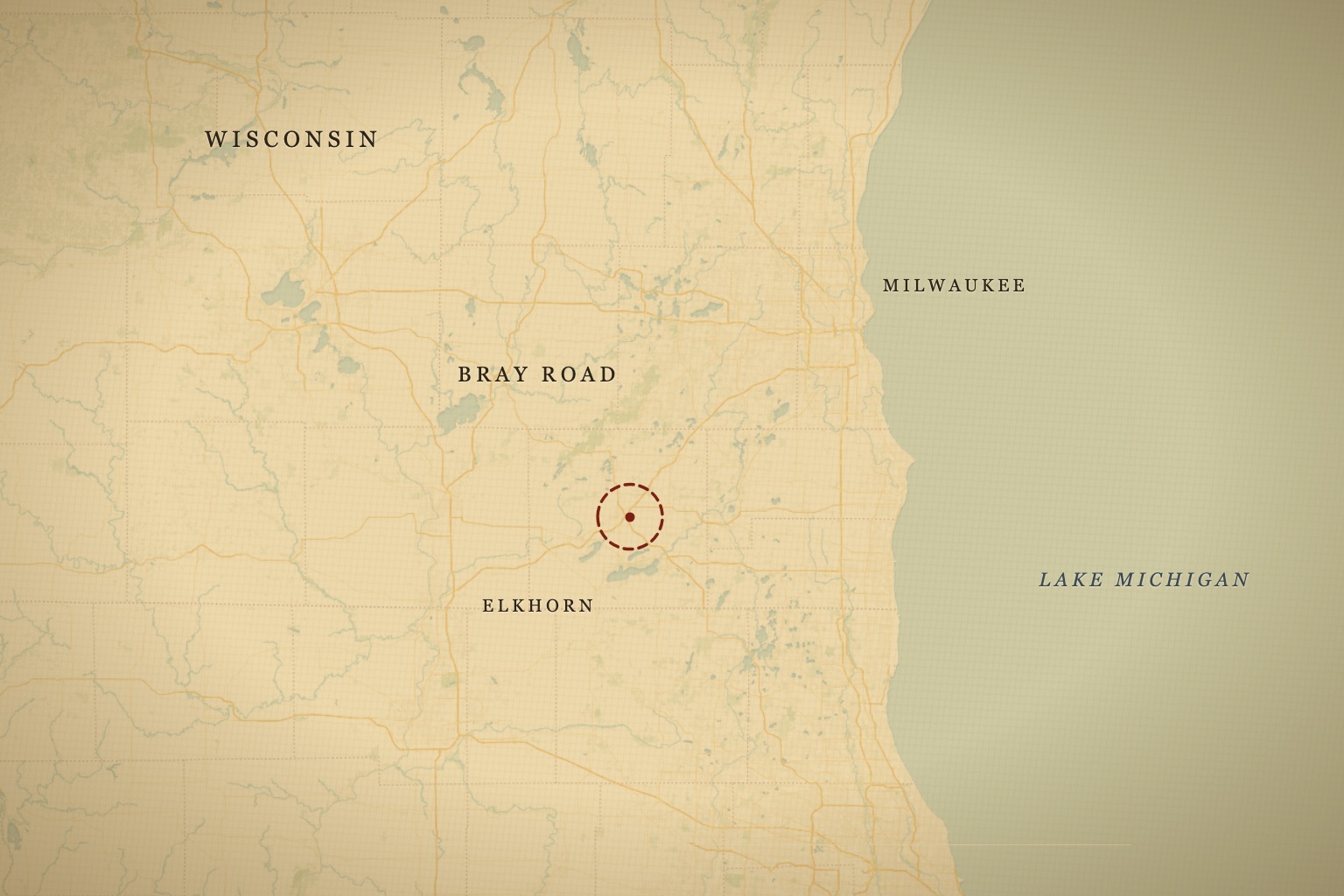
Bray Road runs roughly four miles through open farm country on the outskirts of Elkhorn, the county seat of Walworth County in far southeastern Wisconsin. This is not wilderness. It's a landscape of corn and soybean fields, fencerows, scattered woodlots, marshy creek bottoms, and glacial kettle terrain — an hour from Milwaukee, ninety minutes from Chicago, in a county better known for the resort traffic around Lake Geneva than for anything with claws. The southern unit of the Kettle Moraine State Forest lies a short drive northwest: a long, wooded glacial spine that runs up through the region and functions, wildlife biologists will tell you, as a travel corridor.
That ordinariness is what makes the cluster interesting. The witnesses weren't campers primed for a monster story; they were locals driving a road they drove every day, at the ordinary hours people drive home — after work, after school events, on errands. And the terrain, mundane as it looks, offers real cover and a real food supply: whitetail deer are abundant to the point of being a traffic hazard, roadkill and carrion are constant, the wooded creek corridors connect larger habitat blocks, and southern Wisconsin has a long history of surprise visitors — black bears, cougars, and eventually wolves have all turned up in places the wildlife maps said they shouldn't be. A large canid moving along fencerows at night, feeding on carrion and deer, is not an ecological impossibility here. It's the details of the reports — not the presence of a big animal — that resist explanation.
The Sightings
The reports that surfaced in 1991-92 share a specific, repeated anatomy. In 1989, Lorianne Endrizzi slowed her car on Bray Road to look at what she took to be a person hunched at the roadside. From an estimated distance of about 45 feet, she reported a creature kneeling with food in its upturned palms, with grayish-brown hair, a wolf-like muzzle, pointed ears, and eyes that reflected her headlights. The palms-up detail — hands, not paws, held the way a person holds food — is the detail she could never explain away. She would later say she had no framework for it at the time; only afterward, looking through a book, did she land on the word "werewolf," reluctantly, as the closest available shape.
Around the same period, Scott Bray, a farmer whose family gave the road its name, reported a "strange looking dog" in his pasture — larger and heavier than a German shepherd, with matted gray-brown hair and a build he described as wrong for any dog he knew — and found large tracks afterward. Another local, Russell Gest, described a similar dark, wolf-headed animal standing upright near a wooded area before it walked off. And in the winter of 1990, a group of schoolchildren walking near a creek outside Elkhorn — the account is anchored by young Heather Bowey — saw what they assumed was a big stray dog by the water. As documented in the later investigation, the children reported that when it moved toward them, it rose and moved on two legs, and they ran. Adults checked the snow afterward and found tracks. Separately, a dairy farmer named Mike Etten reported a nighttime sighting from that same stretch of years: a large, bear-like animal sitting up on its haunches at the roadside, holding food in its forepaws. Etten assumed it was a bear — a reasonable call, except that bears were essentially absent from Walworth County at the time.
None of these witnesses knew about the others' reports when they made their own. That independence is the strongest feature of the case. The descriptions converge on the same animal — 5 to 7 feet when upright, gray-brown, wolf-headed, pointed ears, capable of moving on two legs or four, unafraid of people but not persistently aggressive — from witnesses who had never spoken to one another and mostly didn't want to speak to anyone.
The Evidence
Here the record is thin, and it's important to say so plainly. There are no clear photographs from the sighting window, no confirmed track castings, no hair samples, no carcass. What exists is testimony — and one remarkable piece of institutional corroboration: when local reporter Linda Godfrey began investigating for the Walworth County Week in late 1991, the county animal control officer, Jon Fredrickson, showed her a file of accumulated reports he had labeled, simply, "Werewolf." A county office does not open a folder like that as a joke it maintains for years. People had been calling.
Godfrey's story, "Tracking down 'The Beast of Bray Road,'" ran in the final days of December 1991 and went national almost immediately — wire services picked it up, television crews came to Elkhorn, and for a season the town half-embraced and half-endured its new fame, complete with novelty werewolf souvenirs in local shops. What matters for the record is what Godfrey did next. A self-described skeptic when assigned the story, she kept interviewing witnesses long after the cameras left, published her case files in The Beast of Bray Road in 2003, and spent the next three decades documenting hundreds of similar "upright canid" reports across Wisconsin and beyond — work collected in later books like Real Wolfmen — becoming the case's definitive chronicler until her death in 2022. Her research also turned up older regional accounts, including a 1936 report from near Jefferson, Wisconsin, one county north — a night watchman's story, passed down through his son, of a tall, wolf-headed creature encountered on the grounds where he worked. Whatever one makes of a secondhand account at that distance, it suggests the 1989-92 window was a flare-up, not a beginning. Godfrey's own assessment never hardened into a claim: she maintained that the witnesses were seeing something real, and that no conventional explanation fully covered the reports.
The conventional candidates each cover part of the pattern, and officials offered most of them at the time. A large wolf, coyote, or wolf-dog hybrid explains the anatomy but not the upright posture and manual dexterity witnesses described — wolves do not kneel with food in their palms. A bear with mange explains bulk and bipedal moments but not the canid head, and bears were vanishingly rare in the county then. Feral dogs explain volume of animal activity but not size or posture. A hoaxer in a costume explains one sighting, but poorly explains independent reports spread over years — including from witnesses who came forward reluctantly, after the fact, with nothing to gain and a small town's ridicule to lose. No one ever confessed, and no costume ever surfaced. The case has since drawn its share of secondhand treatments — a low-budget 2005 horror film borrowed the name, and cable documentary series later walked the road with night-vision gear — but none of it added evidence. The primary record remains what it was in 1992: the witnesses, the county file, and Godfrey's notebooks.
The Verdict
Strip away the werewolf branding — which the witnesses themselves never asked for, and which several of them visibly disliked — and Bray Road becomes a clean, well-documented sighting cluster: multiple independent witnesses, close-range observations, consistent morphology, a named location, and a paper trail through a county office and a local newspaper. That combination is rarer than it sounds. Most cryptid cases have either enthusiasm or documentation; Bray Road has documentation precisely because its witnesses weren't enthusiasts. What it lacks is physical evidence, and thirty-five years on, that hasn't changed. The most defensible mundane reading — a large, unusually bold canid, its behavior distorted by darkness, adrenaline, and headlights — covers most of the file. The kneeling figure with food in its upturned palms, seen from 45 feet, is the part it doesn't cover, and honesty means leaving that part unresolved rather than sanding it down.
For the serious investigator, Bray Road's lesson is about witness handling. These were ordinary people who saw something on an ordinary road and mostly didn't want attention — some sat on their accounts for years, and told them identically each time anyway. They got a reporter who listened without mocking them, checked their stories against each other and against a county file, and refused to claim more than the evidence carried. Because of that, the record survived. The road is still there, the deer are still there, and Godfrey's files remain the standard for how you document a case like this one — carefully, respectfully, and without forcing the ending.
Track sighting locations from this post on the interactive map.
Free account · mark visited sites · build your field list.
Open the tracker