The Fouke Monster of Boggy Creek
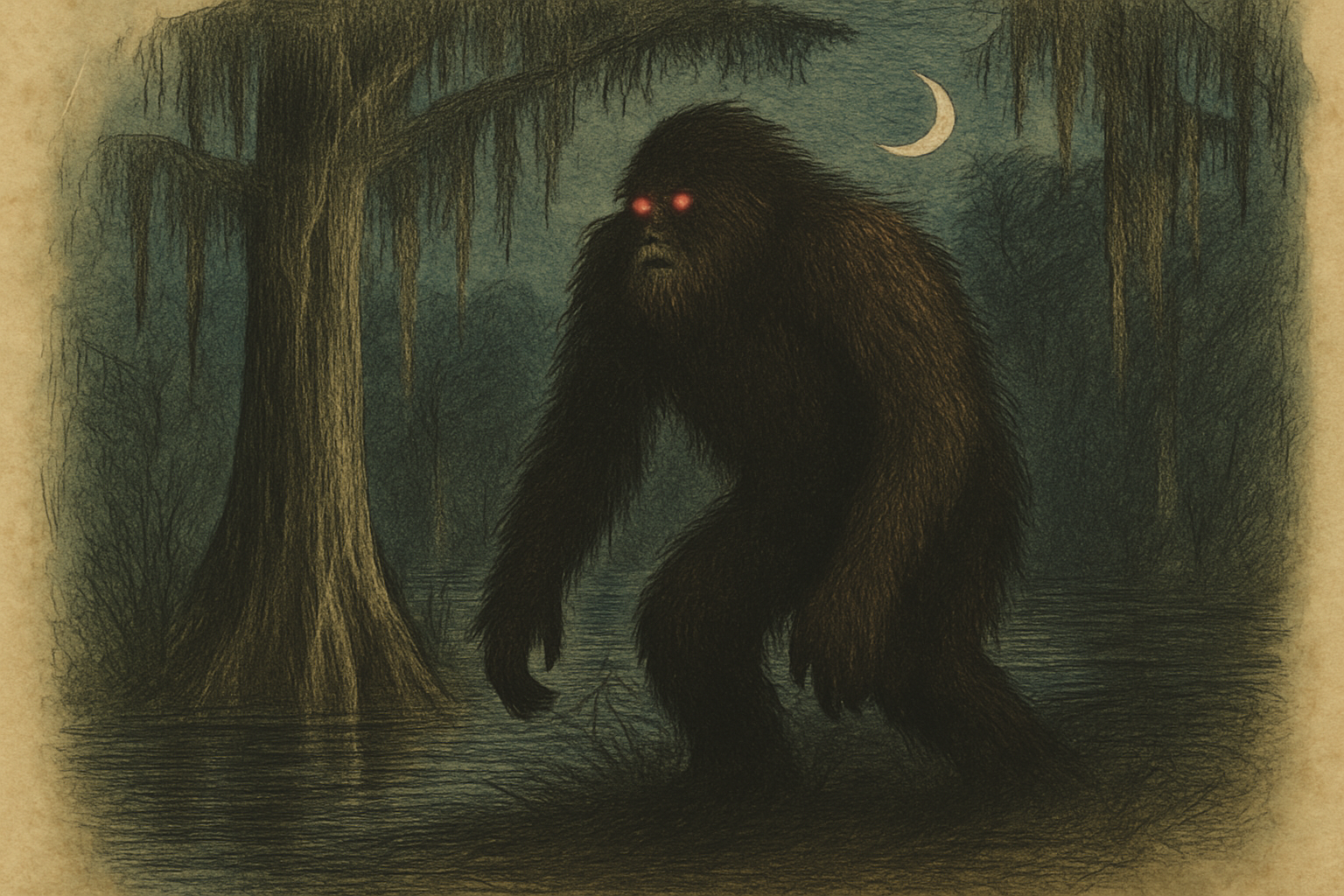
In the early morning hours of May 2, 1971, Bobby Ford came through the front door of his rented farmhouse near Fouke, Arkansas so violently that he went partway through it. He and his wife Elizabeth had moved into the house on Boggy Creek only days before. According to the account he gave the Texarkana Gazette — the reporting that launched the entire phenomenon — a large, hairy creature had reached through a screen window and grabbed at his wife, and later that night attacked Bobby himself in the yard. He was treated for scratches and shock. What made the story stick was not just the drama of it but the number of people who came forward afterward, describing the same tall, dark, foul-smelling thing moving through the same stretch of river bottom. Fifty-five years later, they are still describing it.
The Ford incident is the hinge point of the whole case, and it is worth dwelling on why it landed the way it did. This was a young couple newly arrived in a rural community, not established locals with a reputation for storytelling. The physical aftermath — the damaged screen, the scratches Bobby carried, the door he came through — gave the account a texture that pure rumor rarely has. When the Gazette ran the story, it did not read as folklore. It read as a report of something that had happened to specific people at a specific address, and that specificity is what pulled other residents into the open.
The Location
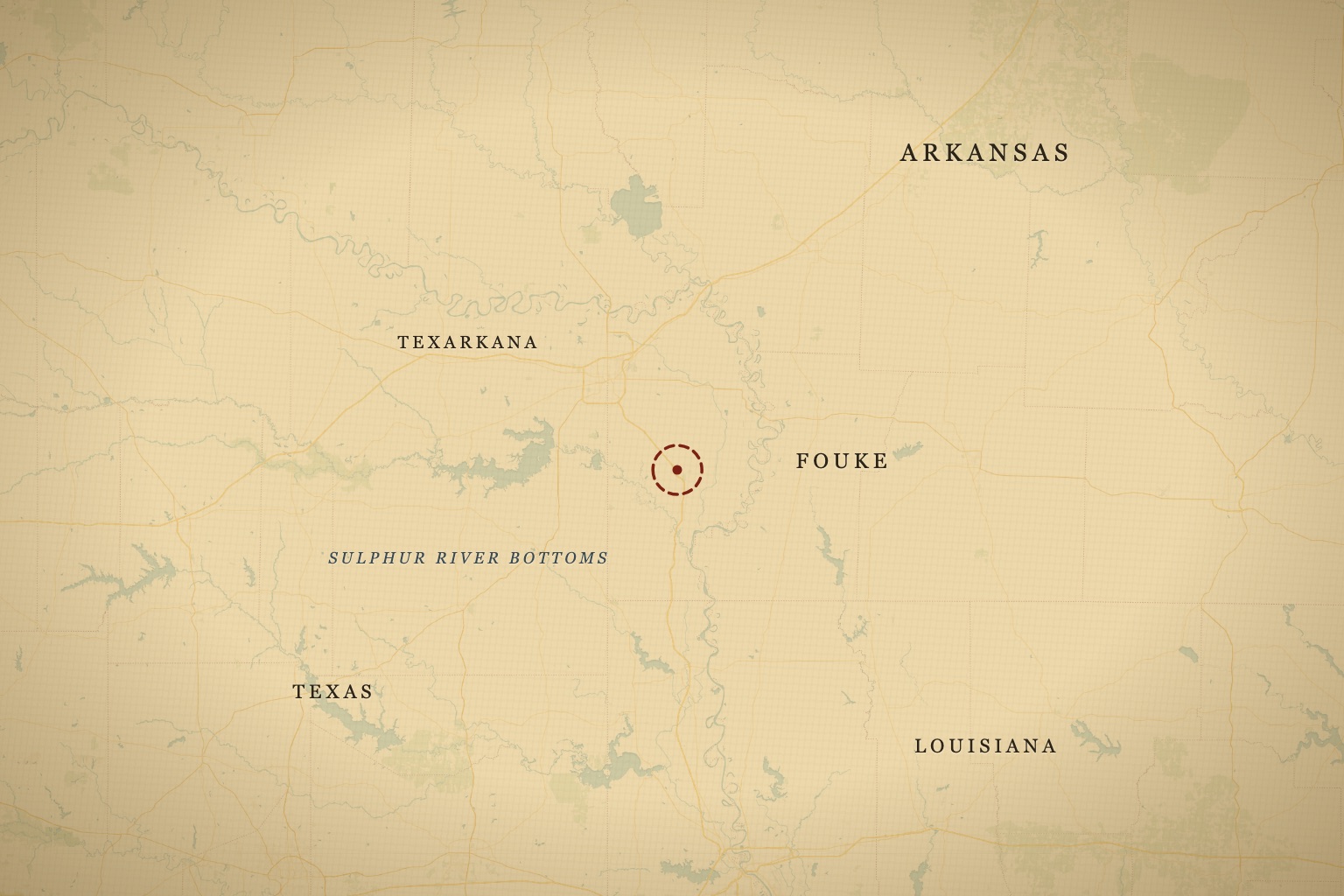
Fouke sits in Miller County in the far southwest corner of Arkansas, roughly 15 miles south of Texarkana on U.S. Highway 71. It is a small town — a few hundred residents — set in the flat, low, water-logged country where the Sulphur River drains toward the Red. This is not mountain terrain. It is bottomland: a maze of sloughs, oxbows, cypress-tupelo swamp, and slow black creeks that flood and recede with the seasons. Boggy Creek, the drainage that gave the creature its film name, winds through this lowland before feeding into the larger Sulphur River system.
The habitat is the whole argument. The Sulphur River bottoms form a dense, seasonally flooded hardwood swamp — bald cypress, water tupelo, sweetgum, oak, and a tangled understory of cane and briar that closes in fast off the few roads. Much of it is difficult to traverse on foot and effectively impassable in wet months, when the river spreads out of its banks and turns miles of forest floor into standing water. The dry-season network of ridges and hummocks that lets a person pick a route through simply disappears under the flood, and what remains is a landscape you navigate by boat or not at all. It holds black bear, deer, feral hogs, alligators at the southern edge, and enormous populations of waterfowl and small game. The Sulphur River Wildlife Management Area protects a substantial block of this bottomland, keeping it undeveloped and lightly traveled outside of hunting seasons.
Geography matters here in a way it does not for many cryptid accounts. The corridor witnesses describe is narrow and consistent: the creek, the river bottoms, and the ribbon of Highway 71 that crosses the low ground. That is a small, definable area, and it is the same area over and over. For anyone asking whether a large, secretive animal could move unseen through southwest Arkansas, the honest answer is that the terrain is built for exactly that. A creature with any capacity for avoiding people would have thousands of acres of flooded, roadless cover to work with, sitting within easy reach of the isolated homes and the single highway where nearly all the sightings occur.
The Sightings
The Fouke reports did not begin in 1971, though that is when they went public. Residents of the area later recalled encounters and unexplained sounds stretching back into the 1940s and 1950s, sometimes attached to an older local name — the "Jonesville Monster," after a nearby community. What the Texarkana Gazette coverage did was give the scattered accounts a single focus and a name. Stories that had circulated privately as things you did not talk about outside the family suddenly had a public frame, and people who had kept quiet for years found they were not the only ones.
The descriptions are strikingly consistent across witnesses. The creature is reported as tall — most accounts place it between six and seven feet, occasionally taller — covered in long dark hair, powerfully built, and accompanied by a strong, foul odor that witnesses repeatedly compare to a wet dog crossed with something rotten. It is most often seen at night, near water, moving with a fast, upright, loping gait. Witnesses tend to stress the speed of it as much as the size, describing something that covered ground quickly and disappeared into the treeline before they had fully processed what they were looking at.
One of the more frequently cited early reports came before the Ford incident itself. In 1971, area residents described the creature crossing roads and prowling near homes in the Boggy Creek area, and livestock owners reported hogs and other animals killed or carried off. Those depredation accounts fit the pattern of a large predator working the edges of the swamp where domestic animals and wild cover meet. Later in the decade and into the 1980s and 1990s, motorists on Highway 71 continued to report seeing a large bipedal figure crossing the road near the river bottoms at night — the same corridor, again and again. Highway sightings are their own category: brief, headlight-lit glimpses, but valuable precisely because the road cuts through the exact low ground where an animal moving between sections of swamp would have to expose itself to cross.
The consistency of the odor detail across unconnected witnesses, decades apart, is one of the harder things to dismiss. A frightened person can misjudge height in the dark, and expectation can shape what a startled witness believes they saw. It is stranger for unrelated people to independently reach for the same idiosyncratic description of a smell — a detail that carries no glamour, that no one embellishes for effect, and that would be an odd thing to invent in the same terms as a stranger down the road. Smell is not the kind of thing a witness borrows from a movie poster.
The Evidence
The most-discussed physical evidence from Fouke is a set of tracks. In 1971, tracks were found in a bean field near the creek that showed only three toes — a detail that has become the signature of the Fouke Monster and sets it apart from the five-toed tracks associated with Bigfoot reports in the Pacific Northwest. Those three-toed prints were photographed and cast, and they remain both the most famous and the most contested piece of the case. Three-toed morphology is anatomically difficult to reconcile with a great ape, whose foot structure would be expected to mirror the broadly human five-toed plan, and some investigators have long treated the tracks skeptically for exactly that reason, raising the possibility of a hoax layered onto genuine sightings. Others argue the tracks may have been misread, produced by an unusual gait or overlapping impressions, or simply unrelated to the animal witnesses described.
The three-toed problem is worth taking seriously rather than waving away. If the tracks are authentic and belong to the creature, they describe an animal that does not fit the standard Sasquatch template at all — which is either a strike against the whole phenomenon or an argument that Fouke represents something distinct from the western reports. If the tracks are a hoax, they do not by themselves discredit the sightings that came before and after them, but they do poison the well, giving skeptics a concrete reason to treat the entire case as manufactured. Either way, the prints cut against a tidy conclusion.
Beyond the tracks, the evidence is largely testimonial: the reported attack on Bobby Ford, damaged window screens at the Ford house, and the sheer volume of independent sightings clustered along one drainage. There is no confirmed body, no accepted biological sample, and no photograph that resolves the question. No hunter has produced a carcass in a region thick with hunters, and no clear image has emerged despite decades of the highway corridor being traveled at night. What exists is a persistent pattern of encounters in a single, well-defined swamp corridor — a pattern strong enough to sustain the tradition and thin enough, in hard physical terms, to keep it from resolving.
The 1972 low-budget docudrama The Legend of Boggy Creek, directed by Charles B. Pierce and filmed in and around Fouke using local residents, cemented the case in popular memory and, for better and worse, is inseparable from how the story is now told. The film was a genuine commercial success and did more than any newspaper column to fix Fouke in the national imagination. That fame is a double-edged thing for the investigator: it broadcast the case widely, but it also gave every later witness a ready-made image to measure their experience against, muddying the line between what people saw and what they had already been taught to expect. The most useful accounts, from that standpoint, are the ones that predate the movie.
The Verdict
Fouke occupies an unusual place in the record. It has one of the longest-running, most geographically concentrated sighting traditions in the American Southeast, tied to a specific creek and a specific stretch of highway that witnesses have named for more than half a century. The habitat is genuinely suited to hiding a large animal — flooded, roadless bottomland that few people ever fully enter. The witness pool is deep and local, and the earliest accounts predate the fame the film brought, reaching back to the older Jonesville stories that circulated before anyone had a camera crew or a poster to reference.
The three-toed tracks are the complication that keeps the case honest. They are the most memorable evidence and, at the same time, the piece most vulnerable to the hoax explanation — a reminder that the Fouke phenomenon is a tangle of credible testimony and unresolved physical claims that don't cleanly line up. That tension is exactly why it's worth the serious investigator's attention. A case with no problems is usually a case that has been smoothed over; Fouke's problems are right on the surface, unhidden, which is more than can be said for a lot of the record. Walk the Sulphur River bottoms at dusk, and the more useful question is not what left those tracks, but why so many unconnected people, for fifty-five years, keep smelling the same thing coming out of the same swamp.
Covered On Screen
- The Legend of Boggy CreekFinding Bigfoot · S4 E2
Track sighting locations from this post on the interactive map.
Free account · mark visited sites · build your field list.
Open the tracker