The Jersey Devil of the Pine Barrens: What the 1909 Witnesses Actually Reported
The Pine Barrens
The Jersey Devil belongs to one specific place, and the place is genuinely strange. The Pine Barrens — locally just "the Pines" — covers more than a million acres of southern New Jersey, a vast spread of sandy, acidic soil that supports dense pitch pine and scrub oak but little of the farmland that surrounds it. It is one of the largest tracts of undeveloped land on the densely populated Eastern Seaboard, sitting almost between Philadelphia and the Jersey Shore, and yet large portions of it remain remote, low, and difficult to move through. Tea-colored cedar water runs through the bogs. Sound carries strangely. People have gotten lost in it within sight of a highway.
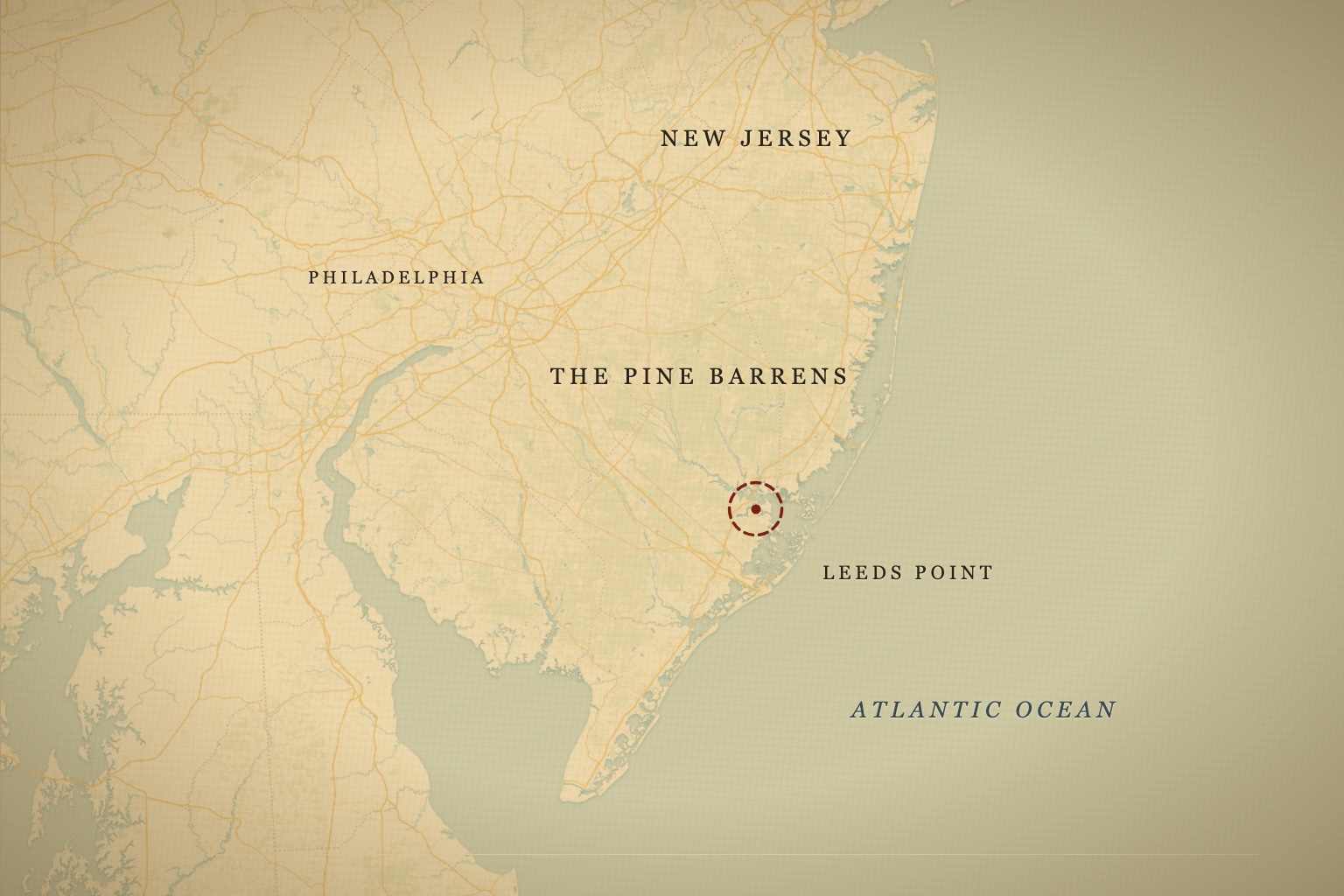
The legend localizes even further than that. The most commonly cited point of origin is Leeds Point, a small community in Atlantic County, in the marshy eastern edge of the Pines. The connection is not arbitrary. The Leeds family genuinely held land in this area in the colonial period, and their name is stitched into the oldest version of the story. For a place to anchor a cryptid for nearly three centuries, it helps for the place to feel like it could hide something — and the Pine Barrens, flat and dark and far larger than a glance at a map suggests, does exactly that. This is the terrain every serious account of the Jersey Devil returns to.
The habitat is worth dwelling on, because it shapes how the reports should be read. The Pines are not mountains; there is little elevation to speak of and few dramatic vistas. What there is instead is cover — uniform, repetitive, disorienting cover. Stands of pitch pine and scrub oak run for miles with few landmarks, the sandy soil swallows footing and muffles approach, and the bogs and cedar swamps create pockets that are genuinely hard to reach on foot. It is the kind of landscape where a person's sense of distance and direction degrades quickly, where an ordinary animal heard but not seen becomes harder to identify, and where a startled deer or a low-flying bird can read as something stranger in poor light. None of that proves anything about the creature. It does explain why this particular forest, more than the open farmland around it, became the home the legend needed.
The Legend, and Where It Actually Comes From
Most cryptid cases begin with a sighting. This one begins with a birth story, and it is worth separating the folklore from the documented history because they are not the same thing.
The standard tale runs like this: in 1735, a Pine Barrens woman remembered as "Mother Leeds," already burdened with twelve children, learned she was pregnant with a thirteenth and, in exhaustion or anger, cursed the unborn child — in the most common phrasing, declaring that this one could be the devil. When the child was born it transformed, growing wings, a tail, and hooves, and escaped up the chimney into the Pines, where it has remained ever since. The creature that haunts the later sightings is usually described with a horse-like or dog-like head, leathery bat wings, a forked tail, clawed limbs, and a bipedal stance.
The history underneath the folklore is more grounded and, in its way, more interesting. Researchers have linked "Mother Leeds" to a real colonial resident, Deborah Leeds, on the strength of a documented detail: her husband, Japhet Leeds, named twelve children in a will he wrote in 1736 — which lines up with the legend's "twelve children" almost exactly. There is no historical record of a monstrous birth, of course. What the documents establish is that the legend was hung on a real family in a real place. Notably, the events are set in the 1700s, but the myth did not circulate widely in print until the nineteenth century — the Jersey Devil's first known appearance in print came in The Atlantic in May 1859. The story is old, but it spent a long time as oral tradition before anyone wrote it down.
The Witnesses: January 1909
Here is where the case stops being folklore and becomes something a field researcher has to take seriously: a documented, large-scale, multi-witness event with a hard timeline.
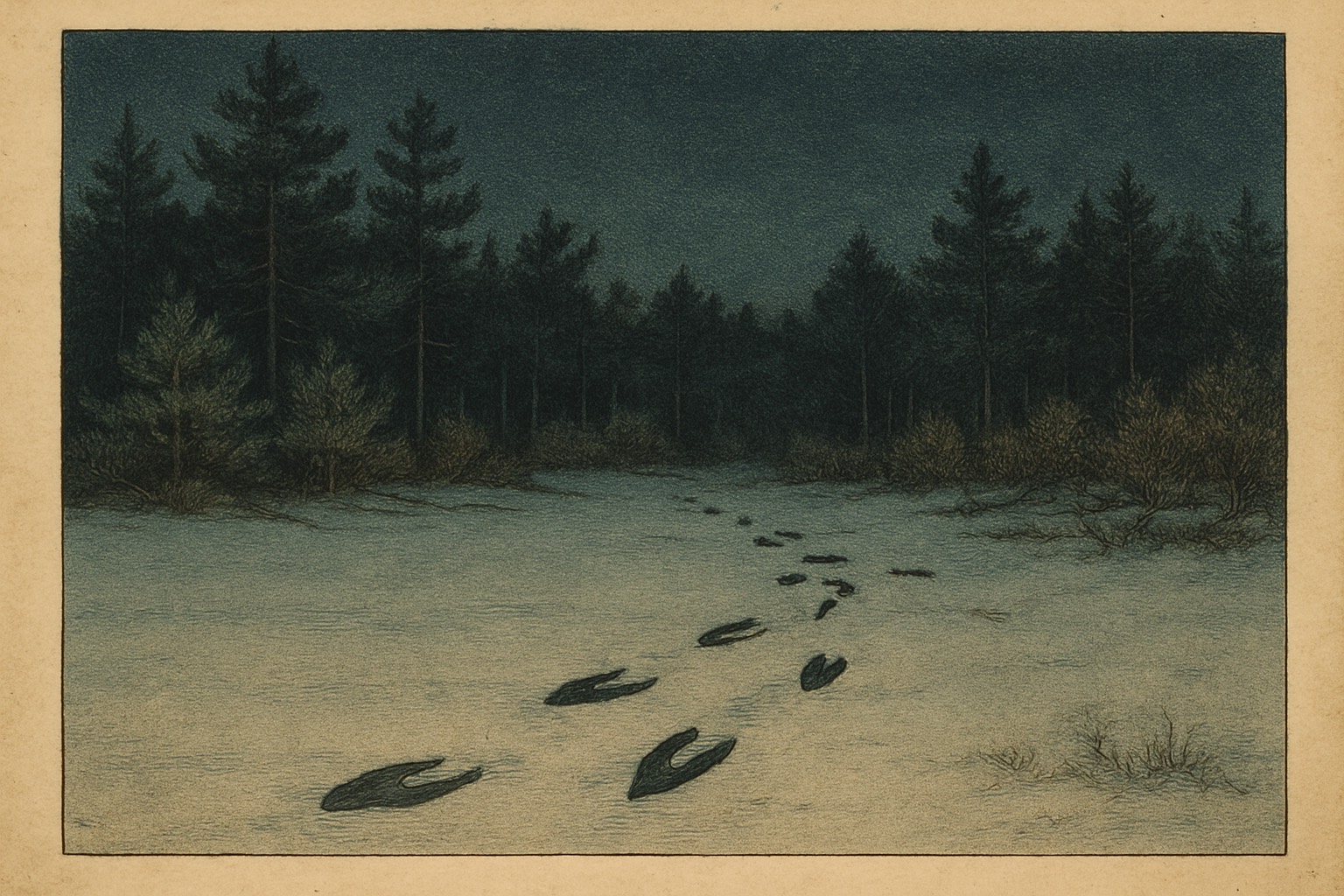
During a single week — roughly January 16 through 23, 1909 — newspapers across South Jersey and the Philadelphia region published hundreds of reported encounters with a strange winged creature. The wave appears to have begun with physical sign rather than a face-to-face sighting: residents across Burlington County reported finding unusual hoof-like tracks in fresh snow, prints that reportedly crossed fields, fences, and rooftops in ways that were difficult to reconcile with any common animal. Then the direct sightings started, and they came from across a wide area in a very short span of time.
The best-documented individual encounter belongs to Nelson Evans of Gloucester City. In the early morning of January 19, 1909, Evans and his wife were woken around 2:30 a.m. by a noise outside their home. They watched the creature from a window for what Evans described as a full ten minutes — an unusually long, deliberate observation rather than a fleeting glimpse. He described it as standing roughly three and a half feet tall, with "a head like a collie dog and a face like a horse." It had long wings, he said, and stood and moved on its back legs. The horse-and-dog description recurs across other 1909 reports as well, which is part of what makes the Evans account valuable: a careful, sustained look that matched the broad outline of what other people, elsewhere, were reporting the same week.
The reaction tells you how seriously contemporaries took it. The coverage was intense enough that some schools closed, some mills and factories let workers stay home, and rural deliveries slowed as drivers grew reluctant to travel isolated roads in the dark. A regional legend became, for several days, a regional event.
Two things about the 1909 wave deserve emphasis for anyone weighing it as evidence. The first is its geographic spread. The reports were not confined to one town or one frightened family — they came from across South Jersey and reached into the Philadelphia area and across the Delaware River into Pennsylvania, a footprint far wider than a single misidentified animal or a local rumor usually produces. The second is its compression in time. This was not a slow accumulation of accounts over months; it was a concentrated burst inside roughly a single week in January, which is exactly the signature of a phenomenon driven hard by newspaper coverage. Both facts cut in two directions at once. A wide, fast-moving wave is harder to attribute to one hoaxer or one spooked witness — but it is also precisely what a media panic looks like when a sensational story hits the front page and everyone who hears a noise in the dark starts looking for the same thing.
The Evidence — and the Hoax
This is where honesty matters most, because the 1909 wave does not survive contact with the evidence cleanly, and pretending otherwise would be a disservice.
The physical evidence amounted mostly to tracks in snow — and tracks in snow are notoriously unreliable. Melting and refreezing distorts prints, ordinary animals produce strange-looking trails in deep snow, and a sufficiently excited public will read significance into marks that have mundane explanations. No carcass was produced. No clear photograph from the event has held up. The reported $10,000 reward from the Philadelphia Zoo for the creature's capture — often repeated as a sign of how seriously authorities took it — went unclaimed, which is the outcome you would expect either way.
And then there is the part of the record that has to be stated plainly: at least one significant strand of the 1909 phenomenon was a deliberate fabrication. Norman Jeffries, a Philadelphia publicist working for the struggling Arch Street Museum, later admitted, in 1929, that he had engineered a hoax to draw paying crowds. The scheme reportedly involved acquiring a kangaroo and attaching artificial claws and wings to it, then exhibiting it as the captured Jersey Devil. That a publicist saw the panic as an opportunity, and successfully exploited it, is a documented fact. It does not by itself explain every one of the hundreds of reports that week, but it sits at the center of the case and cannot be edited out.
Field Assessment
So what is left when you account for the hoax, the unreliable tracks, and the absence of a body?
Less than the legend wants, and more than a flat dismissal allows. The Jeffries hoax explains the most spectacular "captured creature" claims and a good deal of the media frenzy. Misread tracks in mid-winter snow, amplified by front-page newspaper coverage and small-town nerves, can plausibly account for much of the rest — the same feedback loop between press and panic that drives most mass-sighting waves. A genuinely careful assessment has to put fabrication and ordinary misidentification at the top of the list.
And yet a few specifics resist the easy sweep. The Nelson Evans encounter was a long, two-person, pre-dawn observation, not a roadside glimpse, and the horse-and-collie description he gave turned up independently in other accounts that week. The geographic spread was wide and the timeframe was tight. Most of all, the legend's durability is its own kind of data: a story that began as colonial oral tradition, attached itself to a verifiable family on a verifiable patch of land, surfaced in print by 1859, and then produced a documented week of regional panic in 1909 — and is still reported today.
The honest verdict is not a verdict. The 1909 wave was, in large part, a hoax wrapped around a panic. But the Pine Barrens are real, they are far emptier and stranger than their location suggests, and the people who reported what they saw in them were, for the most part, not seeking attention. For the serious investigator, the value of Leeds Point is not a creature waiting to be photographed. It is a near-perfect case study in how legend, landscape, and the press can together produce something that thousands of ordinary people will swear, in the moment, was real.
Covered On Screen
- South Jersey SasquatchFinding Bigfoot · S4 E12
Track sighting locations from this post on the interactive map.
Free account · mark visited sites · build your field list.
Open the tracker