The Loch Ness Monster of Scotland: What the Record Actually Holds
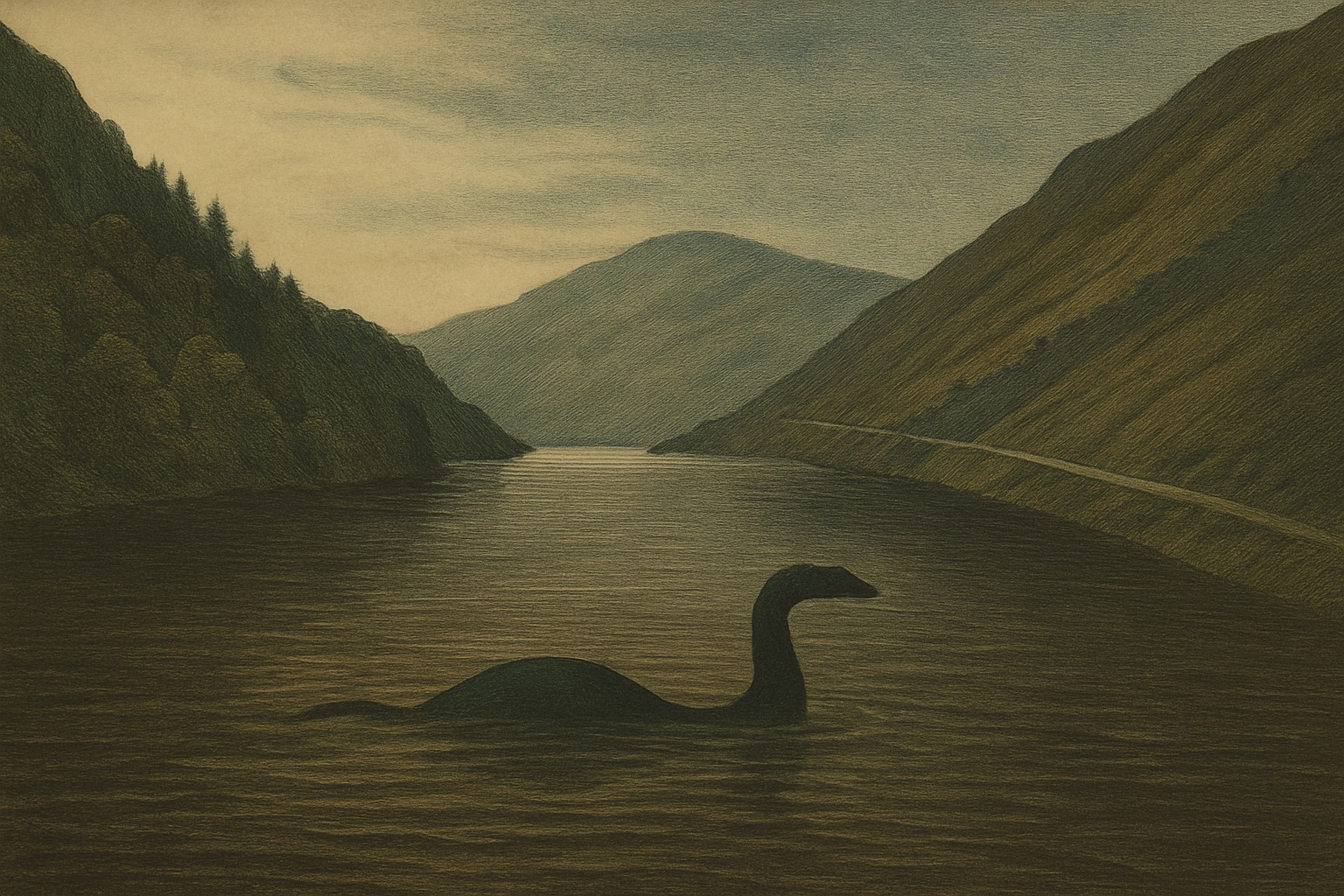
A road, a couple, and a story that wouldn't go away
In the spring of 1933, a new road was being finished along the northern shore of Loch Ness, cutting away the trees that had long screened the water from the A82's predecessors and opening a clear sightline across the loch. That May, the Inverness Courier ran a report from a local couple — Aldie Mackay, who managed the Drumnadrochit Hotel, and her husband John — who described a large creature "rolling and plunging" in the water. The account was written up by Alex Campbell, the loch's water bailiff and local correspondent, and the paper's editor reportedly used the word "monster." The phrase stuck. The story was picked up nationally, and by the end of 1933 the Loch Ness Monster — soon nicknamed "Nessie" — had become one of the most famous mysteries in the world.
The file, though, opens far earlier than 1933. The oldest dated entry is Adomnán's Life of Saint Columba, written around the end of the seventh century, which describes the saint confronting a "water beast" in the River Ness around AD 565. It is hagiography, composed a century after the fact — evidence of a very old story, not of an animal. But people have attached a monster to this water for as long as anyone has written about it.
What makes Loch Ness worth taking seriously is not any single piece of evidence. It's the persistence. Reports of something large in the loch predate the 1933 road by centuries in local lore, and they have continued, in waves, for nearly ninety years since. The Official Loch Ness Monster Sightings Register still logs new accounts most years. A phenomenon that refuses to die deserves an honest look — at what witnesses have actually reported, at the physical evidence, and at what the loch itself can and cannot hide.
The Loch
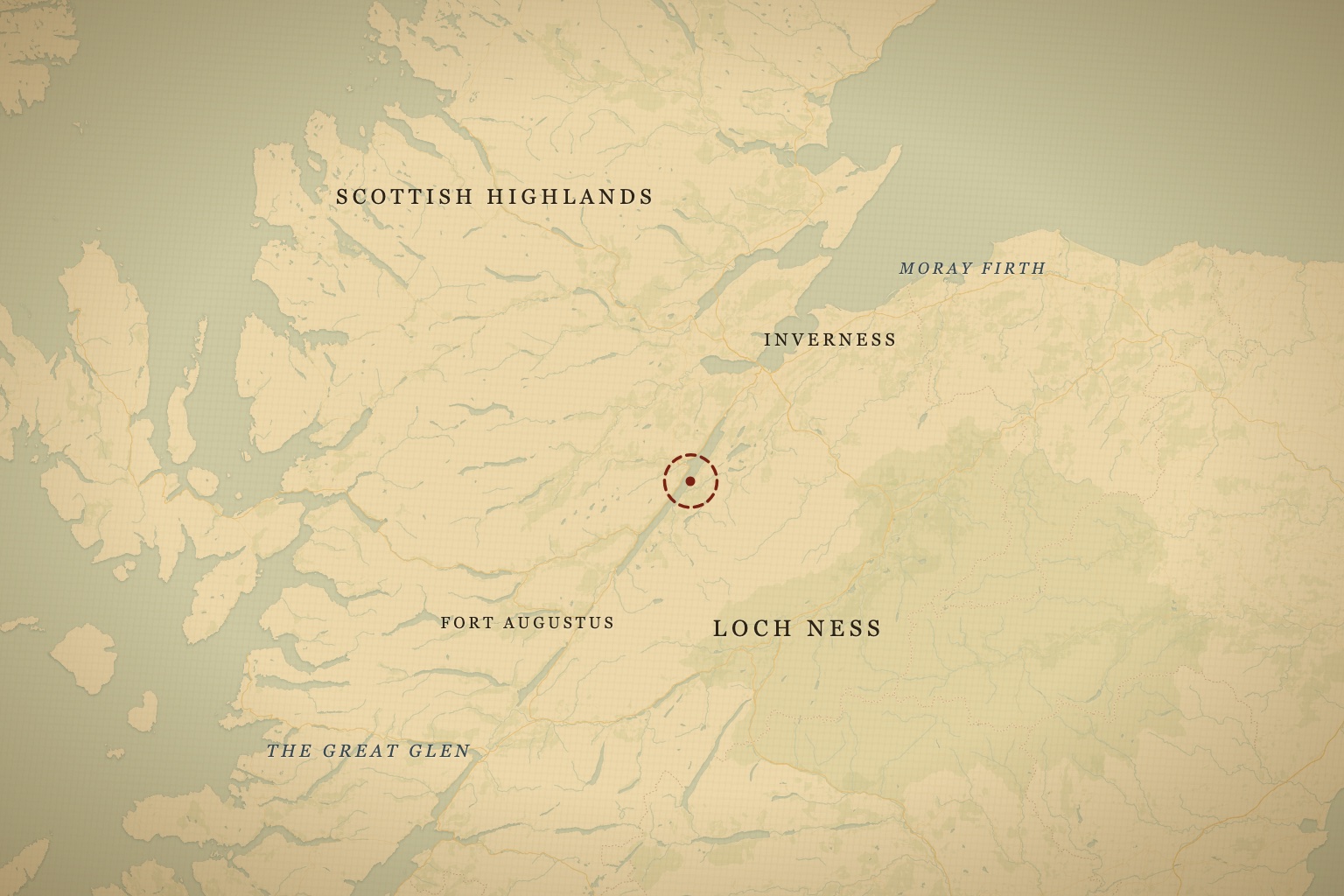
Loch Ness lies in the Great Glen, a long, straight geological fault line that slices across the Scottish Highlands from Inverness in the northeast toward Fort William in the southwest. It is a freshwater loch, narrow and deep, running roughly 23 miles (about 37 kilometers) along the glen. At its widest it is somewhere over a mile across; its surface sits about 16 meters above sea level.
The number that matters most is the depth. Loch Ness is one of the deepest bodies of fresh water in the British Isles, with a maximum depth measured at well over 200 meters in places — deeper than much of the North Sea. By volume, it holds more fresh water than all the lakes of England and Wales combined. The water is famously dark, stained brown by peat washed in from the surrounding hills, which sharply limits visibility for divers and underwater cameras alike.
That combination — enormous volume, great depth, near-zero visibility — is the central fact of the case. Whatever Loch Ness does or does not contain, it is genuinely a place where a large animal could go unseen for long stretches. The loch does not give up its contents easily, and any investigation has to reckon with that from the start.
The loch is also, by the account of the man who knows it best, a machine for producing illusions. Adrian Shine, the naturalist who founded the Loch Ness Project and has worked on the loch since the early 1970s, has spent decades cataloguing the ways its surface deceives: boat wakes that travel the narrow loch and return as moving "humps" long after the vessel is out of sight, wind lines, diving birds, and mirage effects when temperature layers bend light over the water. None of this explains every report — Shine himself has been careful on that point — but it sets a high bar before any surface sighting can be called unexplainable.
The Sightings
The modern era opens with the 1933 reports, but the most discussed land sighting came that same year. On 22 July 1933, George Spicer, a London company director, and his wife told reporters they had seen a large creature cross the road in front of their car on the stretch between Dores and Foyers, along the loch's quieter southeastern shore — a long-necked, bulky thing with no visible limbs that they likened to a prehistoric animal, dragging itself toward the water. Spicer's size estimates grew in later retellings — a documented pattern in eyewitness memory, worth noting without holding it against him. It was a road crossing on dry land, not a glimpse in the waves, and it became one of the foundational accounts.
That same year produced the first purported photograph. On 12 November 1933, Hugh Gray, an employee of the British Aluminium Company, was walking near Foyers after church when he photographed a disturbance in the water. The blurred image has been read in wildly different ways ever since — skeptics suggest a swimming dog carrying a stick; others see an eel-like body at the surface. Examiners reportedly found no tampering on the negative, which settles only that the photograph is genuine, not what it shows.
Then, on 5 January 1934, Arthur Grant, a young veterinary student, reported nearly colliding with a large long-necked creature on the road near Abriachan one moonlit night before it moved off into the loch. His training gave his description more weight than most; skeptics counter that a startled otter or seal could account for it. Over the following decades, sightings accumulated into a recognizable pattern: a long neck or "periscope" rising from the surface, dark humps moving in line, a wake or disturbance with no obvious boat to explain it. The descriptions are not perfectly consistent — which is itself worth noting — but the long-necked, humped silhouette recurs often enough to have become the popular image of Nessie. The Official Loch Ness Monster Sightings Register, maintained by Gary Campbell since 1996, has catalogued well over a thousand recorded accounts and continues to vet new ones.
What's striking in the register of accounts is how ordinary many of the witnesses are: locals, tradespeople, holidaymakers, people with no particular stake in the legend who simply reported seeing something they could not explain. Taking those witnesses seriously, rather than dismissing them, is where any honest investigation has to begin.
The Evidence
The single most famous piece of evidence is the 1934 "Surgeon's Photograph," which appears to show a small head and long neck rising from the water. It carried the name and reputation of Robert Kenneth Wilson, a London gynecologist, and for sixty years it was treated as the definitive image of the monster. Then, in 1994, the photograph was publicly exposed as a hoax — described as a toy submarine fitted with a sculpted head and neck, tied to a deception originating with Marmaduke Wetherell, a filmmaker who had been embarrassed by an earlier Nessie blunder. The blunder is documented: in December 1933 the Daily Mail had hired Wetherell to find the monster, and he promptly announced enormous shoreline footprints — which the Natural History Museum determined had been made with a dried hippopotamus foot, of the kind then sold as umbrella stands. The 1994 account, assembled by researchers David Martin and Alastair Boyd, rests on the confession of Christian Spurling, Wetherell's stepson, who said before his death in 1993 that he had built the model and that Wilson had merely lent the photograph his respectability. The confession came secondhand, late, and is itself debated in some quarters, but the famous photo is now widely regarded as fabricated. That matters: the most iconic image in the case is, by the best available account, a fake.
The film record is more equivocal. In April 1960, Tim Dinsdale, an aeronautical engineer, shot several minutes of 16mm film near Foyers showing a dark object crossing the loch and leaving a wake. In 1966 the RAF's Joint Air Reconnaissance Intelligence Centre analyzed the footage and concluded the object was "probably animate" — the closest any official body has come to endorsing a piece of Nessie evidence — though later analysts have argued it matches a distant boat with an outboard motor. The film helped launch the Loch Ness Investigation Bureau, which from 1962 to 1972 mounted long-lens camera watches along the shoreline every summer without producing a conclusive image.
The instrument record is more interesting and harder to wave away. Loch Ness has been the target of serious, organized searches. In 1972 and 1975, teams associated with the Academy of Applied Science, led by Robert Rines, conducted underwater photography experiments paired with sonar; the resulting "flipper" image was promoted by some researchers as evidence of a large animal, though later analysis raised questions about how much the images had been enhanced. Sir Peter Scott took the flipper photos seriously enough to propose a formal scientific name in Nature in 1975 — Nessiteras rhombopteryx — soon noted to be an anagram of "monster hoax by Sir Peter S."
In October 1987, Operation Deepscan — organized with Adrian Shine's Loch Ness Project — swept the loch with a coordinated line of roughly two dozen boats fitted with Lowrance echosounders and recorded several contacts at depth that were never fully explained: returns stronger than fish, in deep midwater, never relocated. Darrell Lowrance, whose company supplied the sonar units, was quoted afterward saying there was something in the loch they did not understand. And the searching has not stopped: in August 2023, the Loch Ness Centre and volunteer group Loch Ness Exploration ran the largest coordinated search since the Bureau era, with thermal drones and hydrophones that caught sounds the team could not immediately identify. No monster was found.
More recently, a research team led by Professor Neil Gemmell of the University of Otago sampled environmental DNA throughout the loch in 2018, announcing the results the following year — testing the water for genetic traces of the organisms living in it. The survey found no DNA evidence of a large reptile or a plesiosaur-type animal. It did, however, find a notable quantity of eel DNA, leading Gemmell to float the "giant eel" hypothesis as one possibility worth considering: not a confirmation of a monster, but not a clean dismissal either.
The Verdict
Loch Ness is the rare cryptid case with a long, documented paper trail and real scientific instruments pointed at it — and the result is genuinely unresolved rather than simply unproven. The eDNA survey is the strongest argument against a large unknown reptile, and the collapse of the Surgeon's Photograph removed the case's most famous prop. Anyone being honest has to weigh those heavily.
But the loch's depth, volume and peat-darkened water mean that "we found no DNA" is not the same as "nothing is there," and the unexplained sonar contacts have never been fully accounted for. The long-necked, humped silhouette keeps turning up in the reports of ordinary people who had no reason to lie. That is the shape of the Loch Ness case: not a verdict, but a direction — a deep, dark, narrow body of water in the Great Glen that has been watched for ninety years and still has not given up its secret.
For the serious investigator, Loch Ness is less a question of belief than of method — and the case has a working model of it in Adrian Shine, fifty years on the loch, cataloguing its illusions, running its sonar sweeps, and declining to mock the people who report what they see. The witnesses are real. The water is deep enough to hide an answer. And the loch is still being watched.
Track sighting locations from this post on the interactive map.
Free account · mark visited sites · build your field list.
Open the tracker