The Yeti of the Himalayas: A Century of Tracks in the Snow
Tracks at 21,000 Feet
In September 1921, Lieutenant Colonel Charles Howard-Bury was leading the first British reconnaissance expedition to Mount Everest when his party crossed the Lhakpa La, a high pass at roughly 21,000 feet. In the snow, they found lines of footprints. Howard-Bury himself thought they were probably made by a large grey wolf, the prints enlarged and distorted by melting — a sober, plausible read. His Sherpa porters disagreed. They attributed the tracks to a creature they called metoh-kangmi, a term for a wild man of the snows.
When the expedition's account reached Calcutta, a journalist named Henry Newman garbled the translation and gave the world a phrase it has never let go of: the Abominable Snowman. It was a mistranslation — "metoh" is closer to "man-bear" than "abominable" — but the name stuck, and a local tradition that Himalayan peoples had carried for generations became an international mystery.
It's worth saying clearly that 1921 was not the beginning of the record; it was only the moment the record went global. As early as 1832, B.H. Hodgson, the British Resident at the Court of Nepal, published an account in the Journal of the Asiatic Society of Bengal describing how his Nepali hunters had fled from a hairy, tailless, upright creature in the northern mountains — Hodgson guessed it had been an orangutan, which says more about the state of Western zoology than about what the hunters saw. In 1889, Major Laurence Waddell found large footprints in the snow of northeast Sikkim at around 17,000 feet; his guides told him without hesitation that they belonged to a hairy wild man of the snows. Waddell concluded the tracks were made by a bear. That template — locals certain, Westerners divided, and the evidence itself consisting of footprints in melting snow — was set nearly a century before most of the famous expeditions, and it has barely changed since.
The Location
The yeti's reported range covers the high Himalaya — Nepal, Tibet, Bhutan, and the Indian state of Sikkim — with the densest cluster of accounts coming from the Khumbu region of eastern Nepal, the Sherpa homeland below Everest. This is terrain that resists investigation like almost nowhere else on Earth: glaciated valleys above 14,000 feet, rock walls, crevasse fields, and weather that closes routes for months at a time. The zone where most tracks are found — the belt between the last scrub forest and the permanent snowline — is exactly the zone humans cross quickly and rarely linger in.
That remoteness cuts both ways. It means the region genuinely could conceal a rare, wide-ranging animal — the snow leopard was a ghost to Western science for decades, essentially unphotographed in the wild until George Schaller's work around 1970, and the Himalayan brown bear remains scarce, nocturnal in habit, and poorly studied to this day. It also means most yeti evidence consists of what the mountains preserve best and distort worst: footprints in snow. High-altitude sun sublimates and melts snow at a rate that can double the apparent size of a print in hours, merge a line of small tracks into single large ones, and turn a fox trail into something monstrous in a single afternoon. Almost every disputed yeti track was photographed hours or days after it was made. That single fact hangs over the entire physical record.
One more piece of context matters, because it comes from the people who actually live there. Sherpa tradition does not describe one yeti; it distinguishes several. Investigators working with locals in the 1950s — notably the naturalist Charles Stonor — recorded a rough taxonomy: the dzu-teh, a large, shaggy animal that attacks yaks and cattle and walks mostly on four legs; the meh-teh, the man-sized, man-shaped figure of the classic accounts; and the small teh-lma of the forested valleys. Western coverage collapsed all of these into a single monster. The locals never did — and the dzu-teh, at least, reads today like a straightforward description of a brown bear.
The Sightings
The record is longer and better-witnessed than most people assume.
In 1925, N.A. Tombazi, a Greek photographer traveling with a British geological expedition near the Zemu Glacier in Sikkim, reported watching an upright figure moving across a slope at around 15,000 feet — visible for about a minute, dark against the snow, stooping occasionally as it walked. Descending later, his party found footprints. Tombazi was a Fellow of the Royal Geographical Society, not a man given to sensational claims, and he never insisted the figure was anything more than unexplained.
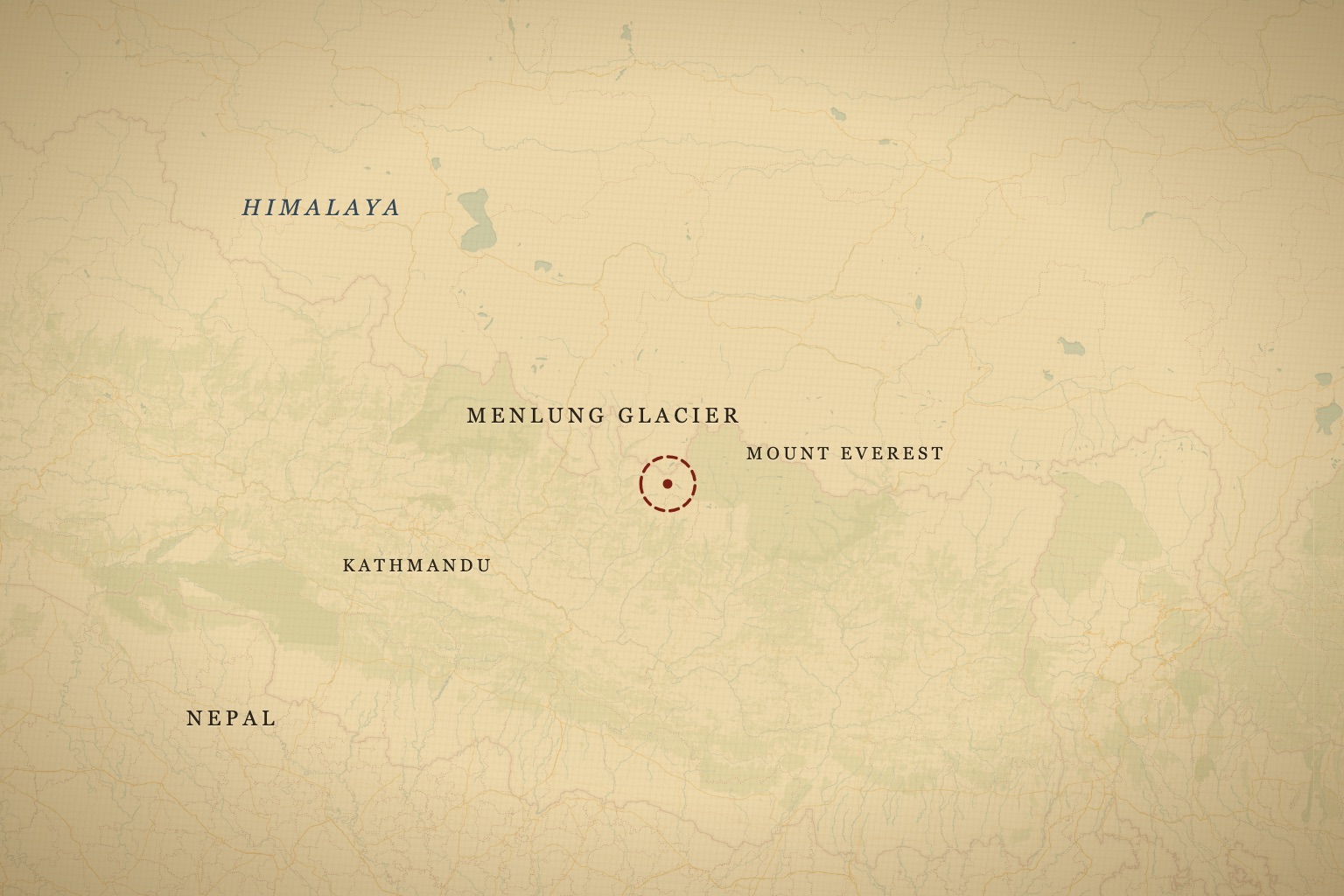
In 1951, Eric Shipton and Michael Ward, two of the most respected mountaineers of their era, photographed a line of tracks on the Menlung Glacier during an Everest reconnaissance. In 1953, Edmund Hillary and Tenzing Norgay reported large footprints during the first ascent of Everest itself; Tenzing wrote that his own father claimed to have seen a yeti twice.
The Shipton photographs triggered the first wave of dedicated searching. In 1954, the Daily Mail funded the Snowman Expedition — the first expedition mounted specifically to find the yeti rather than to climb something. Its members, including the journalist Ralph Izzard and the naturalist Charles Stonor, spent months in the Khumbu, followed lines of unexplained tracks for miles at altitude, and examined the famous "yeti scalp" kept at Pangboche; hair analysis at the time came back inconclusive, matching no known animal in the reference collections. Between 1957 and 1959, the Texas oilman Tom Slick bankrolled a series of expeditions with the brothers Peter and Bryan Byrne among the field men — expeditions that reported more tracks, gathered droppings and hair, and sampled the monastery relics. By Peter Byrne's own account, a fragment of the Pangboche hand left Nepal folded into the luggage of the actor Jimmy Stewart and his wife Gloria — one of the stranger verified footnotes in the history of the field.
The most careful track find belongs to a scientific expedition. In December 1972, the Arun Valley expedition of Edward Cronin Jr. and Dr. Howard Emery — a multi-year ecological survey, not a monster hunt — camped on a ridge near the Kongmaa La at about 12,000 feet. Overnight, something walked directly between their tents, leaving a line of fresh nine-inch prints showing a broad foot and distinct toes. The tracks approached up one steep slope and descended another that the team members themselves struggled to negotiate in daylight. Cronin, who documented the find in his book on the Arun, remained cautious about interpretation — but the prints were fresh, photographed within hours, and made at night within feet of sleeping scientists. It remains the hardest track evidence in the file.
And Reinhold Messner — arguably the greatest high-altitude climber who ever lived — reported a close encounter with a large, dark, upright creature in eastern Tibet in 1986, an experience that sent him on a years-long personal investigation.
The Evidence
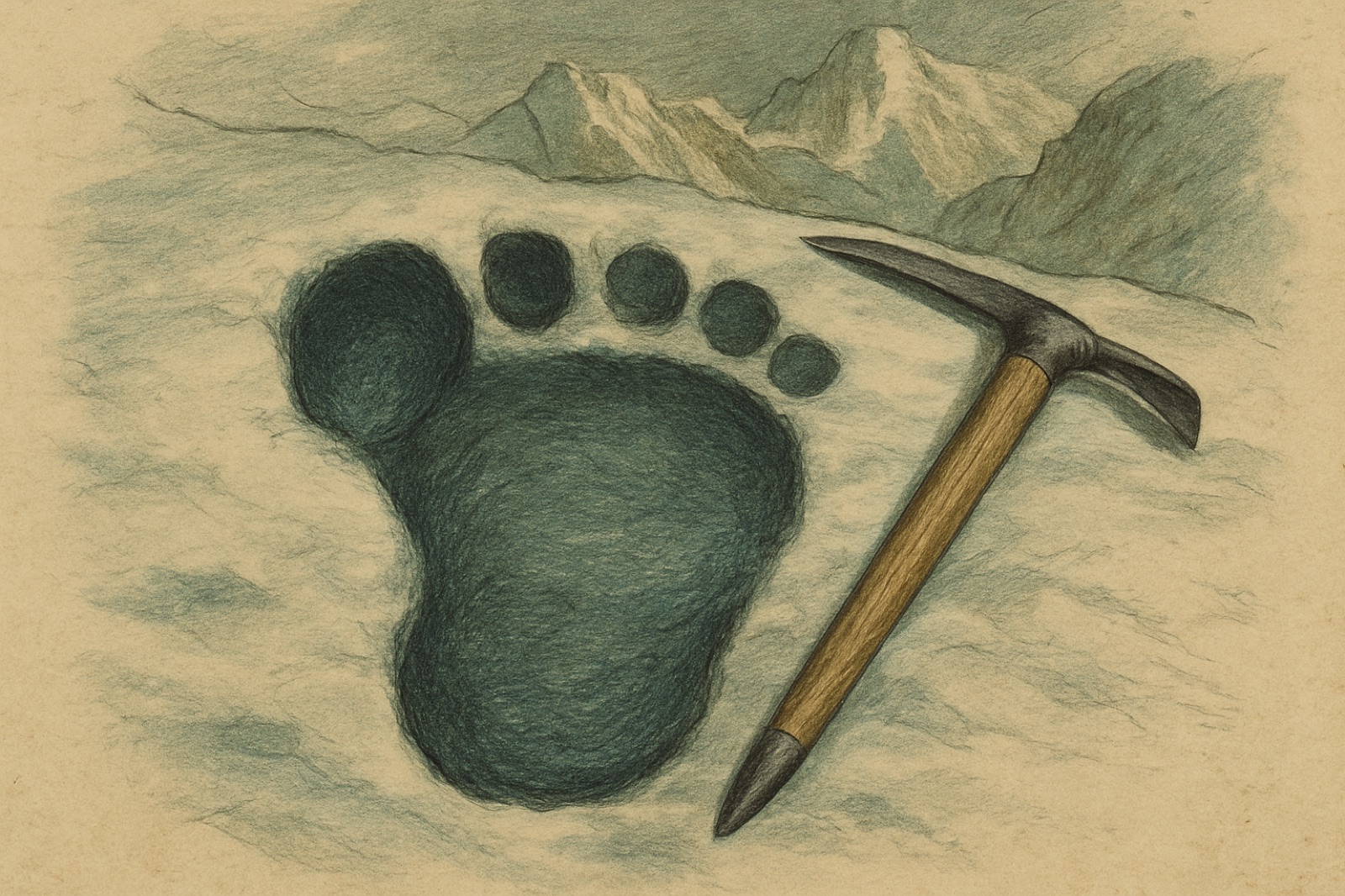
The single most important artifact is Shipton's 1951 photograph: one clear print in shallow snow, about 13 inches long, photographed next to an ice axe for scale, showing a broad foot with a large offset toe. It has never been definitively explained. Skeptics argue it could be an overlapped animal track expanded by melt; defenders note the print's crispness and anatomy. Michael Ward, who stood next to the print when it was photographed, wrote decades later that a deformed human foot — and barefoot travel at altitude by local people is documented — could not be ruled out. Seventy-five years on, it remains the yeti debate in a single frame.
The photographic record also carries a built-in warning. In 1986 — the same year as Messner's encounter — a British runner named Anthony Wooldridge photographed what appeared to be a dark, upright figure standing in the snow near Hemkund in the Garhwal Himalaya. Experts were initially impressed. A follow-up survey the next year with stereo photography settled it: the figure was a rock. Wooldridge accepted the finding with good grace, and the episode is now the standard citation for how honestly mistaken a competent witness can be at distance, in snow, at altitude.
The physical relics have fared worse than the photographs. The famous "yeti scalp" kept at Khumjung monastery was loaned to Edmund Hillary's 1960 expedition — village elder Khunjo Chumbi traveled with it as escort — and examined by labs in Chicago, Paris, and London; the verdict was that it had been molded from the hide of a serow, a Himalayan goat-antelope. The Pangboche hand, sampled during the Slick expeditions, was eventually subjected to DNA analysis that pointed to human origin. In 2013–2014, geneticist Bryan Sykes at Oxford ran a much-publicized analysis that matched two Himalayan hair samples to an ancient polar bear sequence — a genuinely startling result until a 2015 reanalysis by other researchers showed the samples were better explained by the ordinary, if rare, Himalayan brown bear.
Then came 2017. A team led by biologist Charlotte Lindqvist published a genetic analysis in Proceedings of the Royal Society B examining nine purported yeti samples — hair, bone, tooth, and scat from museums and private collections, including material attributed to the monastery relics. Eight came back as bears: Himalayan brown bear, Tibetan brown bear, and Asian black bear. The ninth was a dog.
The tracks, meanwhile, keep coming. In April 2019, the Indian Army's official account posted photographs of a line of enormous single-file prints — reported at 32 by 15 inches — near Makalu Base Camp. Wildlife biologists pointed out that a bear's hind feet registering over its forefeet in snow produces exactly this kind of oversized single-file line. The Army stood by its photos; the mountains, as usual, offered nothing further.
The television record is part of the story too. Josh Gates took Expedition Unknown to Nepal and Bhutan in late 2016 for a multi-part hunt that retraced much of this same ground — the monastery relics, the high passes, the sample collection — and the creature turned up again in Tales From the Explorers Club (Season 1, Episode 5, 'Monsters and Myths'), which goes back to the primary sources — relaying the footprint accounts of Tenzing Norgay and Edmund Hillary themselves, two Explorers Club legends whose 1953 reports appear earlier in this piece, straight from the club's own archive. Our sister site The Dossier Project tracks what those expeditions actually found, episode by episode.
The Verdict
The honest reading is that every physical yeti specimen tested so far has turned out to be something else — mostly bears. Messner himself concluded after years of searching that the yeti tradition describes the Himalayan brown bear, an animal that can stand upright, walks through the same passes, and is rare enough that even locals seldom see one clearly. The Sherpa's own dzu-teh category points the same direction, and the Sykes affair showed how even the most exciting genetic lead resolves, on careful reanalysis, into Ursus arctos.
But that isn't quite the end of it. The bear identification explains the relics; it explains less well what Tombazi watched walk across a slope for a full minute, or the anatomy of the Shipton print, or what stepped between the Cronin-Emery tents at midnight and climbed a slope that challenged fit men in daylight. And the Lindqvist study carried a quieter finding: the Himalayan brown bear is genetically distinct and isolated — its lineage split from other brown bears hundreds of thousands of years ago — an animal science still knows remarkably little about. The mountains were hiding something after all. Whether they're hiding anything more is a question the Himalaya is under no obligation to answer quickly — and a hundred years of tracks in the snow suggest people will keep climbing up to ask.
Covered On Screen
- Abominable SnowmanFinding Bigfoot · S4 E8
Track sighting locations from this post on the interactive map.
Free account · mark visited sites · build your field list.
Open the tracker